
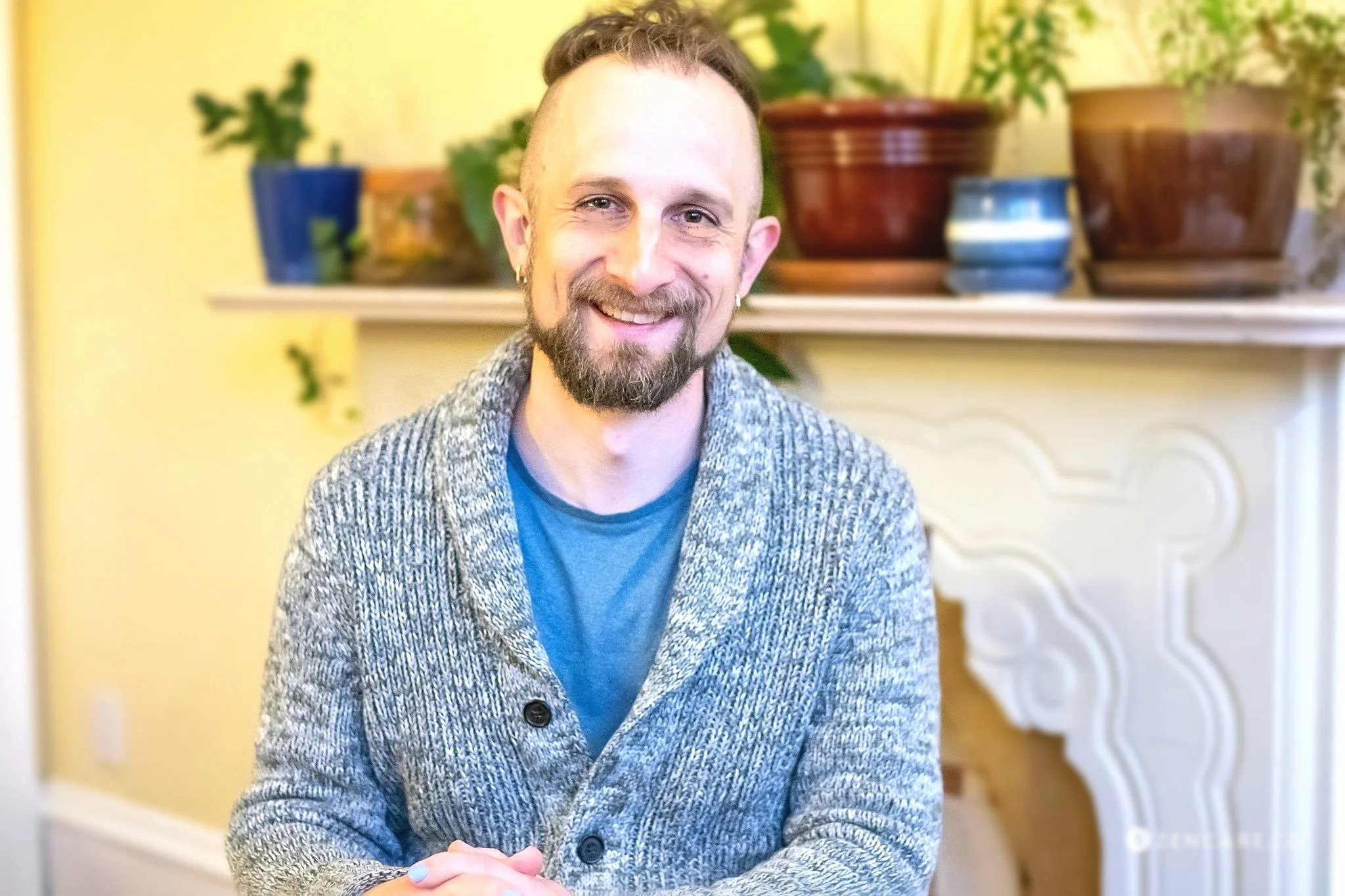
Hi, I’m Justin
I bring careful thought and analysis to every level of the therapy process - the relational and power dynamics that shape our communication, the specifics of what actually matters to you rather than the generic assumption that "feeling better" will get you to a rich and meaningful life. I value taking the time to get to know you with depth and nuance, and work to understand both your inner world and your particular experience of the very hard and complex world we live in.
I use Acceptance and Commitment Therapy (ACT), an evidence-based approach with several decades of research behind it. It is less about arguing with your thoughts and feelings, and more about getting clear on what you want your life to be about and practicing the flexibility to move that way. Alongside it, I practice enacted consent-based care: we won't work on something unless we've first discussed whether it's worth your time and effort, and gone over any risks or discomfort that might come with it. It's important to me that you have a say in how we do the work of therapy, not just what we work on. That might mean deciding together whether to stay with something painful or come back to it another week, or talking through why I'd suggest a particular area or skill before we start working on it.
If you have questions about how I work, or whether I might be a good fit for the particular work you are looking to do in therapy, email me or we can set up a quick phone call.
(they/he).
-
I work with people who want to help, and who are trying to balance taking care of themselves with taking care of everyone else. I've done this work for years, with medical students and attendings, therapists and long-time organizers. I'm not going to suggest meditation or a self-care routine and pretend that's enough. Instead, I'll get into everything from the details to the bigger questions with you and then figure out together what a workable plan looks like.
-
I'm queer and nonbinary, and I've worked with people in our community for years. My work here can look very different depending on what someone needs. If you want help saying out loud what you've been asking yourself privately for years, we can work on that. And if you come in about stress or loss or anxiety, I won't route it back to your gender every other session on the assumption that's the real issue.
-
I write letters of support for gender-affirming surgery, using an informed-consent model rather than a gatekeeping one. To meet requirements from insurance companies and surgeons, I write to WPATH Standards of Care version 8. I've also signed the GALAP pledge, and provide letters free of charge if insurance doesn't cover it.
I try to keep this process straightforward and collaborative. Email me with any questions and we can talk for fifteen minutes by phone, so you can get a sense of what it would be like.
-
I work with people deciding whether polyamory fits them, and with people well into it — a new partner, an agreement that's shifting, one relationship ending while others keep going. When working to understand complex relationship dynamics, I bring curiosity about the specifics of someone's relationships, and a broad knowledge of the many different ways people design relationships to fit their needs.
-
I've worked with people in the kink community for years — people still figuring out whether it's for them, and people who've been in it a long time and are sorting out the relationships and arrangements they're already in. I see people who want to use therapy as a way to understand and navigate kink, and I also see people in the kink community who just want regular therapy without having to explain themselves or hide their kink life from a therapist.
-
I follow AI closely and I work with people who are concerned about societal and existential risks from AI, and with those working directly on those problems. If you have specific questions about how I approach this clinically, please email me or set up a quick phone call.
-
I work with people in co-ops, group houses, cohousing, and other shared arrangements, and with people deciding whether to start one. I'm always interested in how these households work as systems — everything from who does what to how decisions get made to relational dynamics and house culture.
-
I've worked in college counseling centers and with students at every stage — from first-years adjusting to a residence hall to ABD students in a complicated relationship with an advisor. I love helping someone figure out what to focus on — often there are many things changing every semester, and it helps to look at what you're actually experiencing with depth while also responding to what's happening each week.

Experience:
Concentric Psychological Services, 2019 – Present
Roger Williams University Counseling Center, 2019 - 2020
Lifespan Physician Group, Young Adult Behavioral Health, Gender and Sexuality Clinic, 2016 – 2019
Rhode Island College, Counseling Center, 2015
Univ. of Rhode Island Counseling Center Postdoctoral Fellowship, 2015
Mercy Hospital, Employee Assistance Program, 2014
University of Michigan, Doctoral Internship, 2013
Indiana University of Pennsylvania, PsyD in Clinical Psychology, 2013
Indiana University of Pennsylvania, MA in Clinical Psychology, 2010
Oral Roberts University, BS in Psychology, 2007